
Lee County Projected Date Types
Four dates are often mistaken for one. A Lee County Jail sentence-release date comes from the court term, jail credit, and any lawful earned-time allowance. A GDC sentence end or maximum release date reflects the state sentence calculation. A Tentative Parole Month, or TPM, marks a month for final Board review. The actual release date records what ultimately happened.
| Date | Owner | Meaning |
|---|---|---|
| County sentence release | Jail and sentencing court | Sentence expiration after applicable credit and earned time |
| Sentence end or max release | GDC | State calculation based on sentence records |
| Tentative Parole Month | Parole Board | Month for final review, not guaranteed release |
| Actual release | Releasing agency | Date custody or a term actually ended |
A transfer is not always a community release. Lee State Prison acts as a transfer hub and hosts the Albany Transitional Center. A person leaving that prison may move within GDC or into transitional custody rather than become fully discharged.
Find Lee County Projected Release
Start with custody type, not a broad name search. Lee County Jail houses pretrial defendants, certain sentenced misdemeanants, and people awaiting transfer. Each group has a different date path. State inmates use GDC records. Federal custody uses federal sources, not a Georgia sentence calculator.
- Check whether the person is in Lee County Jail, GDC custody, or another system.
- For a pretrial detainee, review bond and the next court order. Do not expect a sentence-release date.
- For a county misdemeanor sentence, ask the jail and court for the sentence, jail credit, earned time, and current release date.
- For a state prisoner, search GDC Find an Offender by name, GDC ID, or case details.
- If a TPM appears, compare it with the Parole Board explanation.
- Confirm disputed state data in writing with GDC Inmate Records and Information.
The main Lee County released inmate search connects date research with jail, court, VINE, state, and federal status checks.
GDC Lee County Release Fields
The GDC offender search is the main public channel for an adult state prisoner. Search tools can use a name, ID or case number, age, and identifying details. The result may show sentence and status information. GDC warns that web data should be verified by written correspondence before it is treated as complete.
The official GDC offender search displays its search and verification terms.
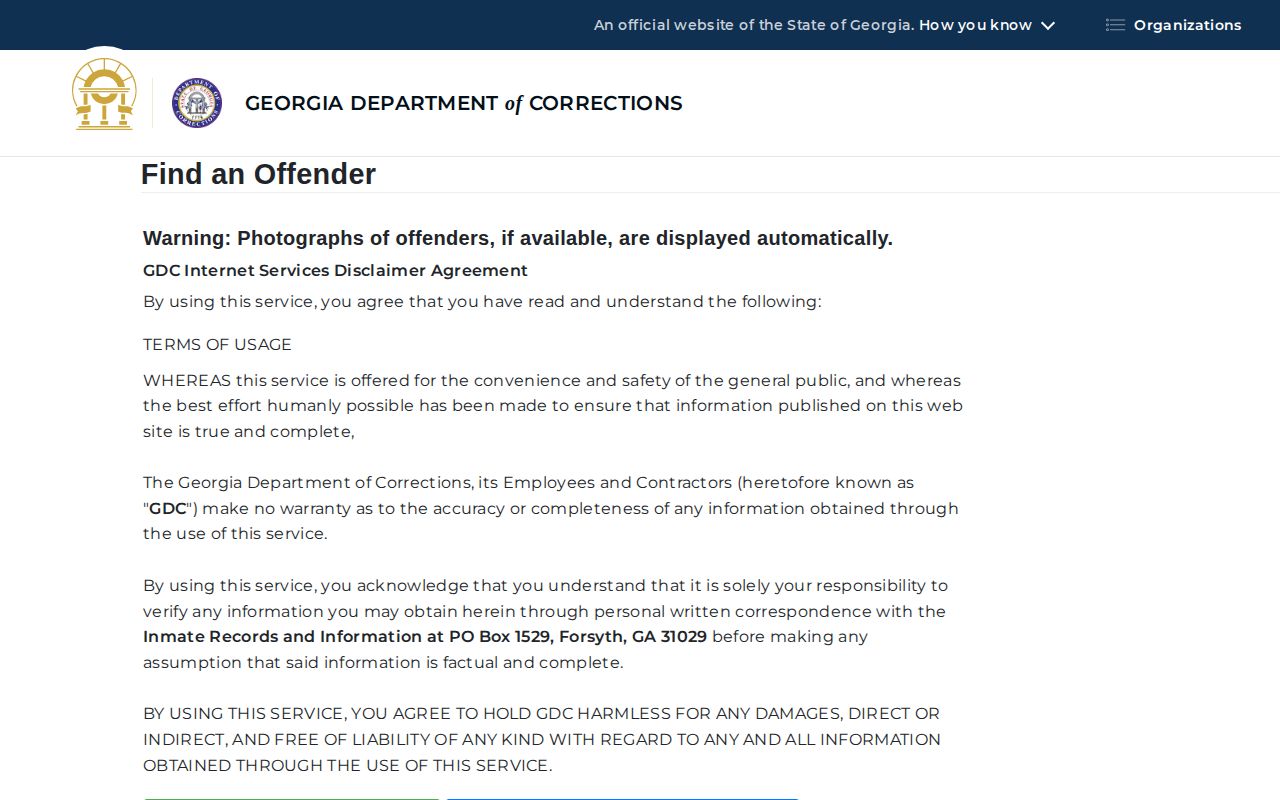
This state portal fits a Lee State Prison sentence. It does not calculate bond release for Lee County Jail.
Lee County Jail Earned Time
O.C.G.A. § 42-4-7 says a county inmate sentenced to confinement is released when the sentence expires, less earned-time allowances. The court supplies the sentence. Jail credit and earned time can then affect the working date. The law does not create a fixed projected date for a person awaiting trial.
For pretrial custody, release can turn on bond, recognizance, dismissal, plea, transfer, or a new court order. Lee County Magistrate Court handles bond and preliminary hearings, while Superior Court holds felony criminal records through its Clerk. Ask for the current order and jail computation instead of subtracting days from an arrest date.
Note: A county earned-time rule and GDC incentive credit are separate systems with different eligibility and record owners.
GDC Credits Change Release Dates
Georgia administrative rules in Rule 125-2-4 distinguish sentence begin and sentence end concepts. The begin date can account for jail time served and special court instructions. The end date reflects the maximum term plus the effects of non-running time and earned-time credits. A corrected jail-credit entry, a new order, or a period when the sentence does not run can therefore change the public date.
The Performance Incentive Credit program can reduce length of stay for eligible offenders who make satisfactory progress in programs, school, vocational work, work details, and good conduct. GDC excludes death sentences, terms of two years or less, life sentences, and non-parole-eligible or minimum-mandatory offenses. PIC is not a simple public formula.
The official PIC source shows the program and eligibility limits.
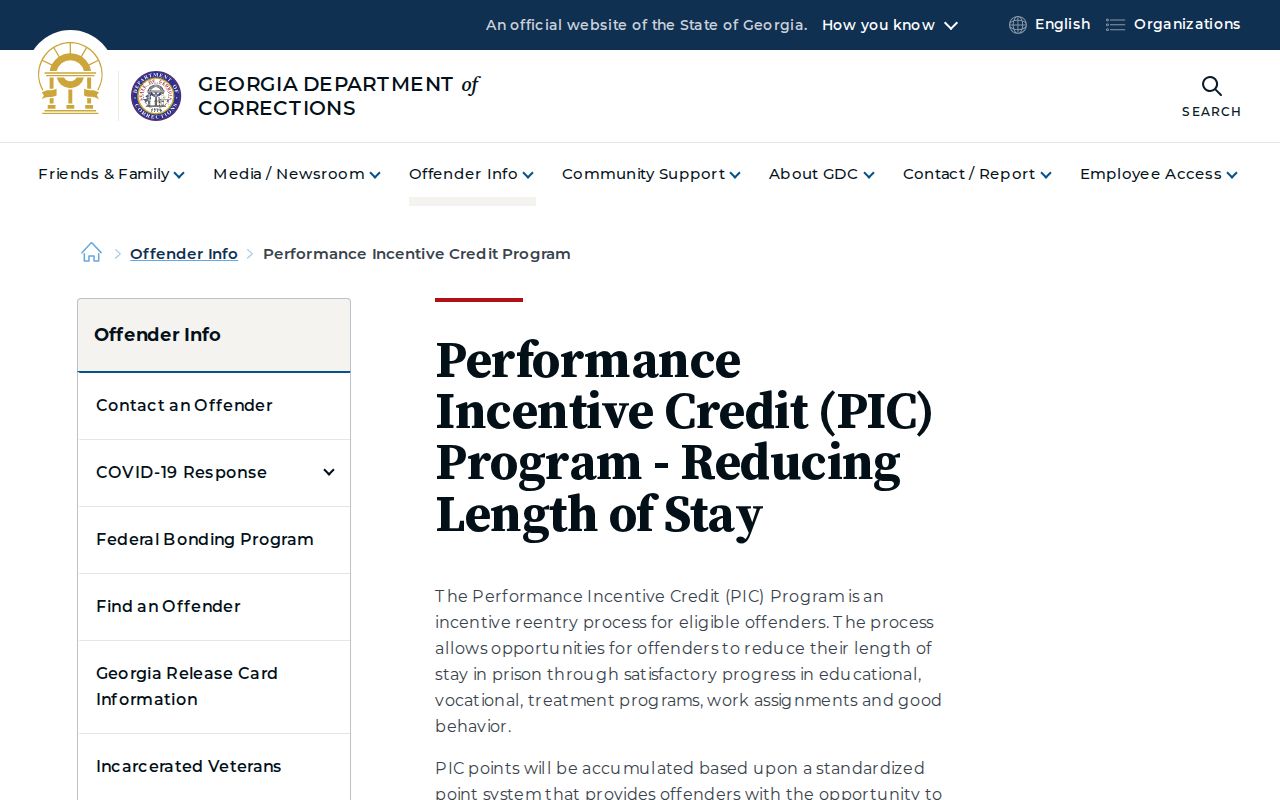
Only the current GDC record can show how a credit decision affected one person's computed term.
Lee County Parole Timing
Most parole-eligible Georgia inmates become statutorily eligible after one-third of the prison sentence. Eligibility is not release. The Board applies guidelines, may deny parole, or may set a TPM. Final review can lead to a release date, but misconduct or unmet program conditions can postpone or cancel the tentative month.
Georgia does not apply a generic 85 percent rule to every state sentence. The Parole Board states that listed non-life serious violent felonies committed on or after January 1, 1995 are not parole eligible and require service of 100 percent of the prison term imposed by the judge. The list includes murder, rape, aggravated child molestation, aggravated sodomy, aggravated sexual battery, armed robbery, and kidnapping. Fourth-felony recidivists, life without parole, and death sentences have separate exclusions.
The Georgia parole process explains final review.
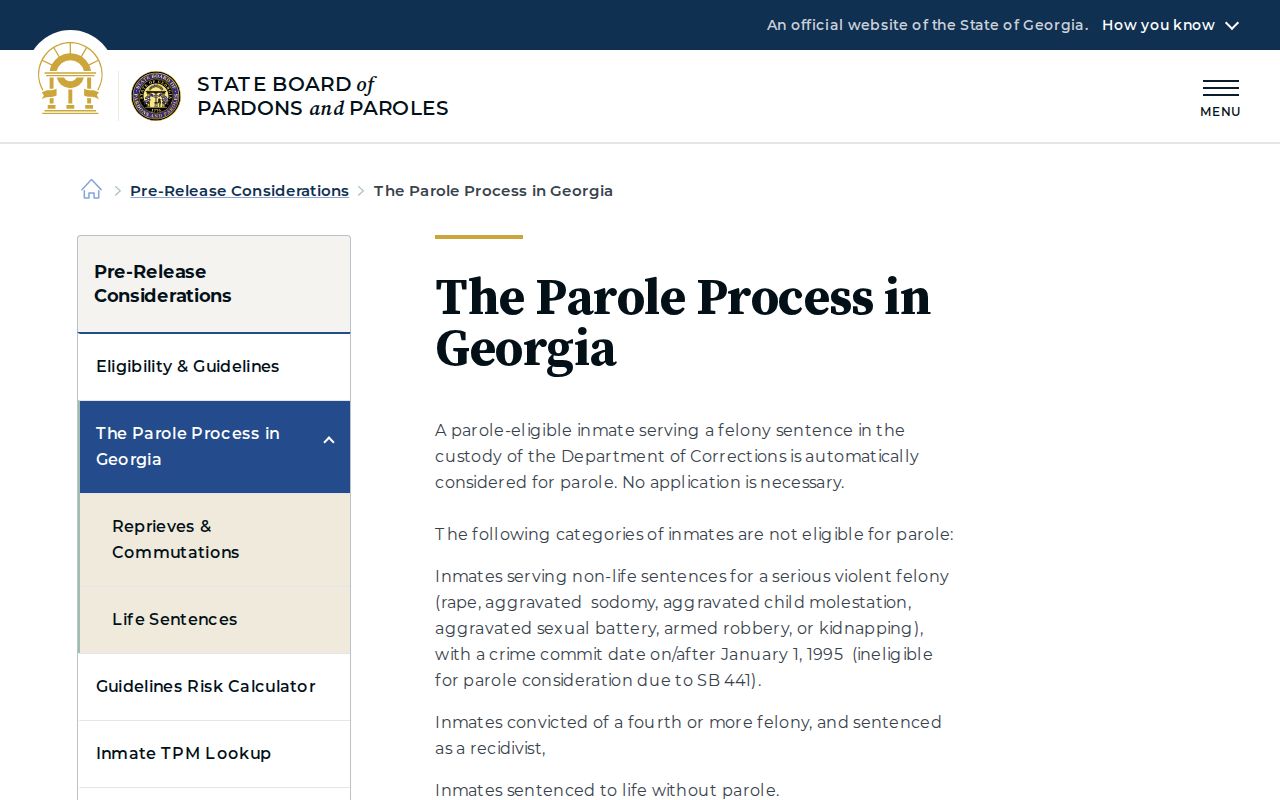
This process is why a TPM must not be reported as the actual release date.
Why Lee Release Dates Move
A date can change after it first appears. The cause may be routine record correction or a new legal event. Ask the agency to identify the factor instead of trying to reverse-engineer a sentence from the web display.
| Factor | Possible effect | Confirm with |
|---|---|---|
| Jail credit correction | Moves sentence begin or end calculation | Court and GDC |
| Earned credit award or loss | Shortens or extends current projection | Jail or GDC |
| Non-running time | Stops sentence time in defined circumstances | GDC records |
| Detainer or hold | May prevent community release | Holding and receiving agencies |
| Court order | Changes sentence or custody terms | Clerk and corrections agency |
| Parole decision | Sets, moves, denies, or withdraws parole release | Parole Board |
Lee County Release Date Channels
One search cannot cover every Lee County release path. Citizen Connect addresses county jail activity. The Sheriff and court hold the source records for a jail sentence or bond event. GDC owns the state sentence calculation. The Parole Board owns tentative parole timing, while Georgia VINE provides status alerts based on participating agency data.
Choose the channel from the case, then keep a short record of what each source showed and when it was checked. If two dates differ, ask which one is a projected sentence end, a maximum date, a tentative parole month, a court-ordered date, or an actual release. Those labels often explain the conflict before any correction is needed.
Confirm Lee County Actual Release
If a projected date passes while a person still appears confined, check detainers, discipline, transfer status, sentence recalculation, and data lag. Georgia VINE can send a custody-change alert, but it is not a certified release record. Use the VINELink Inmate Search as an alert channel, then verify with the jail, GDC, court, or receiving agency.
A detainer is a request or authority from another agency that can keep a person in custody or cause a transfer after the local term ends. It is one reason a sentence date can pass without community release. Ask the holding office whether another agency accepted custody, and request the transfer or release entry when the public display is unclear.
A county release record can show the actual time and reason. A GDC discharge record can establish state status. A court order explains a legal change. These records answer different parts of the same question, so a strong check compares them rather than relying on one projected field.
For a Lee State Prison case, also determine whether the person moved to another GDC site or transitional custody. For Lee County Jail, distinguish a bond release from transfer to GDC or federal custody. The word released can describe the end of one facility's control even though another agency takes custody at once.
Lee County Court Date Records
The sentencing court supplies the legal term that starts a county or state calculation. For a Lee County felony case, the Superior Court judgment can show the sentence, credit instructions, probation, and later amendments. Magistrate Court handles bond and preliminary matters, but it is not the final record source for a felony sentence. A bond date and a projected sentence release date answer different questions.
When the public corrections date conflicts with known court action, ask the Clerk for the judgment and any amended order. Then give the case number and order date to the jail or GDC records office. Corrections staff calculate custody from the controlling sentence record. They do not replace the judge's order, and the court does not maintain each later administrative credit entry.
Lee County Transfer Date Checks
Lee County has two very different institutions on Pinewood Road. The Sheriff operates Lee County Jail, while GDC operates Lee State Prison. Their records are not interchangeable. A person can leave the jail for GDC and still be confined, or leave Lee State Prison for another state site without being discharged.
Ask for both the event type and receiving agency. A county transfer record can identify a handoff to GDC, federal custody, another county, or another authority. A GDC movement can identify a prison transfer or transitional placement. Neither event should be labeled as an actual release to the community unless the record supports that result.
Correct Lee Release Date Errors
Correction starts with the office that owns the disputed field. Send a court-order problem to the clerk, a county calculation problem to the jail, and a state sentence field problem to GDC Inmate Records. A parole timing problem belongs with the Parole Board. Include the full name, identifying number, case number, source screenshot, and the order or record that appears to conflict.
Do not ask one office to certify another agency's date. A careful request states the field label and asks whether it is current, projected, maximum, tentative, transferred, or actual. That wording helps the office answer the precise date question and preserves a clear record of the response.
Document Lee County Date Checks
Save the source name, search date, exact date label, and any identifying number used. A printed or saved result can show what the public system reported at that moment, while a later agency response can explain a change. This is useful when GDC recalculates a sentence, a court corrects jail credit, or the Parole Board changes a tentative decision.
Do not erase the distinction between an estimate and a completed event when making notes. Mark a TPM as tentative, a sentence end as calculated, a transfer as continued custody, and a release record as the actual facility exit. Clear labels make later calls to the jail, court, GDC, or Board shorter and more accurate.
Public Record Search
Sponsored Results