
Lee County Court Record Follow-Up
Georgia Courts E-Access sends users to provider sites and may require an account. If an online result is thin, contact the Clerk of Superior Court or use an in-person courthouse records option. The clerk can be reached at (229) 759-6018, with records handled from the County Courthouse at 100 Leslie Highway in Leesburg. Magistrate Court is not a court of record, so an early bond event and a later Superior Court felony disposition should be checked as distinct files.
Lee County Three-Day Release Check
The Citizen Connect Inmate Confinements page has no official Released in Last 72 Hours view. It offers Current Confinements, Admits by Date Range, Last 7 days, and a custom span limited to 31 days or less. Those tools can assemble a three-day activity set, but the results remain booking and custody clues.
A three-day review works by comparing recent admits with the current roster. A recent admit who still appears in Current Confinements is not confirmed released. A recent admit who no longer appears may have left Lee County Jail, but the exit may be bond, sentence completion, dismissal, or transfer. Only a release record or corroborating official source explains the change.
Check Lee County 72-Hour Releases
Use a fixed start and end point so the same three days are compared across all sources. Around a weekend, include the full calendar dates instead of assuming that the portal uses an exact rolling clock.
- Open Inmate Confinements and select Admits by Date Range.
- Use Last 7 days, then review only the most recent three calendar days, or set a custom three-day span if available.
- Compare each likely match with Current Confinements.
- Check the Daily Report and Arrest Search for the arrest or booking event.
- Use Georgia VINE for status and alert information.
- Confirm bond or disposition through the proper Lee County court.
- Request the Sheriff's release record for the date, time, reason, and receiving agency.
The Jail Releases: 24 Hours page is the better route for a same-day view. A search for one named person across more than one custody system belongs on the county home search.
Lee County 72-Hour Search Fields
The official interface exposes search controls, not a verified release ledger. This table limits claims to the labels confirmed in Lee County research.
| Portal item | How it helps the three-day check |
|---|---|
| Current Confinements | Tests whether the person remains in the current public jail view. |
| Admits by Date Range | Finds admissions across the chosen days. |
| Last 7 days | Provides a broader set that can be narrowed to three days. |
| Custom date range | Supports a selected span of no more than 31 days. |
| Charges | Shows or filters the charge context attached to the booking data. |
| Arresting Agency | Identifies or narrows the agency tied to an arrest. |
A formal release record may provide booking number, release date and time, release reason or type, court or case number, bond status, and receiving agency. The public portal should not be said to display those items unless its live row actually does.
Lee County Release Roster Workaround
Citizen Connect has Last 24 hours and Last 7 days presets, yet neither is labeled as a release list. The local roster quirk means the three-day task is a comparison exercise. Recent admission plus absence from current confinement raises a question; it does not answer it.
Keep a short worksheet with the full name, admission date, arresting agency, current-confinement result, court result, VINE status, and final confirmation source. That prevents two people with similar names from being merged and preserves the difference between a transfer and community release.
The 31-day limit is a portal window only. It says nothing about how long the Sheriff's Office must keep a jail record. Older or missing data should move to a specific records request.
Lee County 72-Hour Report Delay
The Citizen Connect Daily Report warns that incident and accident reports may not be available for up to 72 hours after filing. That warning applies to report availability. It does not define an inmate-release feed, release posting schedule, or jail processing deadline.
This distinction is easy to miss because the same number appears in the desired search window. A Daily Report item posted on the third day may document an earlier incident. It does not show that the person was released within those 72 hours. Use its category and event date as supporting context, then check the jail record.
The official screen below preserves the local warning in context.
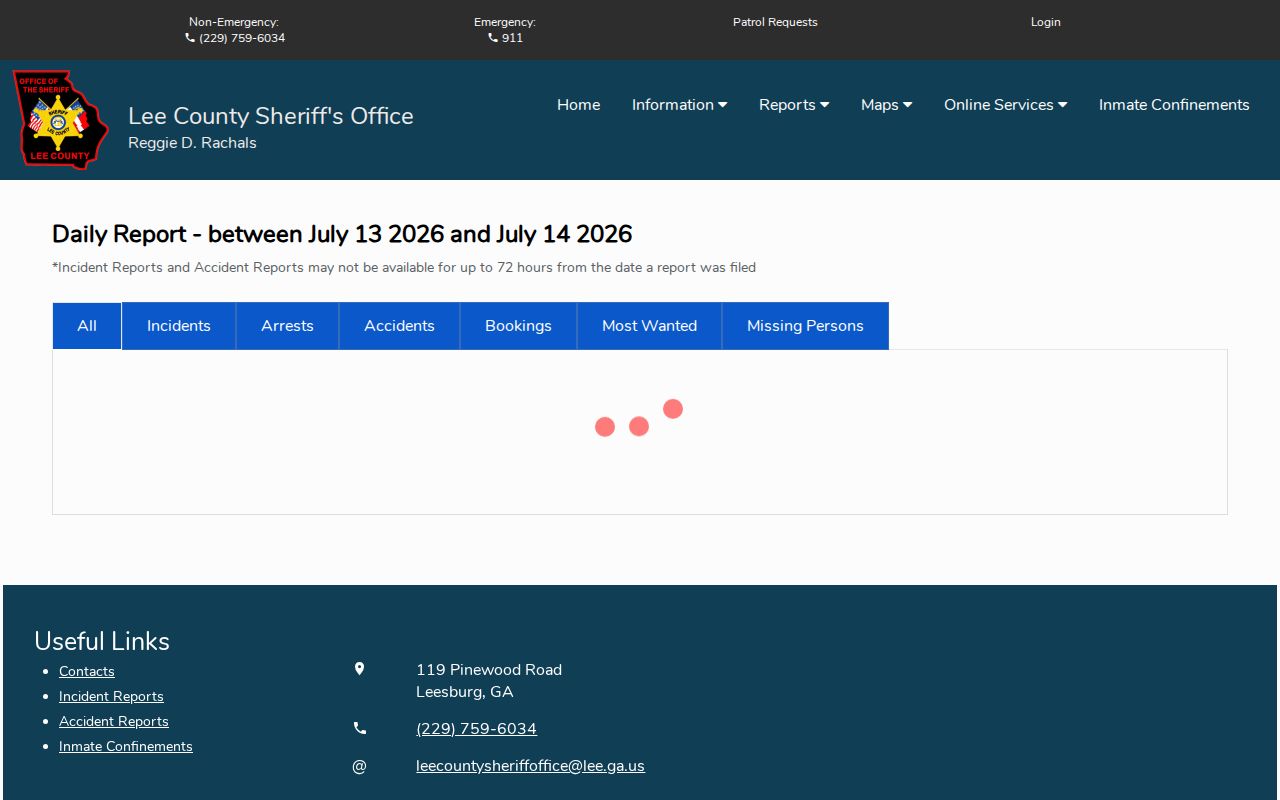
Note: No official refresh cadence was found for Lee County inmate data, so a new jail event may not appear at once.
Weekend Lee County Jail Releases
A wider window can catch a Friday admission reviewed on Monday, but the calendar alone does not establish release. Bond may be set by Magistrate Court, while the Criminal Justice Center completes the physical release. A felony case may later proceed in Superior Court.
Holiday and weekend staffing can also make sources appear out of sequence. The arrest event, court order, jail exit, VINE status, and public portal update may carry different times. Record the source and time for each item. Give the facility release record the most weight for the actual exit, and the court file the most weight for why the case changed.
- Current confinement
- A person shown in the portal's present public custody view.
- Admission
- The intake event that starts a jail stay.
- Release
- The end of that facility's custody, either to the community or another authority.
- Disposition
- The court's action or outcome in the criminal case.
Confirm Lee County Three-Day Exits
If Citizen Connect does not settle the result, use the Lee County Open Records route. Sheriff's Office records should be directed to 119 Pinewood Road, PO Box 610, Leesburg, GA 31763, at (229) 759-3334. Give a full name, date of birth, and approximate booking date, then request the release date, release time, release reason, and receiving agency.
For bond and preliminary matters, consult Magistrate Court. Felony disposition and sentence records belong with Superior Court. Georgia VINE may show custody status or send a change alert, but it does not replace a certified jail or court record.
| Possible result | Confirmation path |
|---|---|
| Released on bond | Bond record and Sheriff's release record |
| Sentence or time served | Court order and jail exit record |
| Transferred to GDC | Receiving agency field and GDC offender search |
| Federal or ICE pickup | Jail transfer record, then the relevant federal locator or court |
| No clear public result | Specific Sheriff's Office records request |
Lee County Custody After Release
Leaving the county roster does not always mean leaving confinement. Lee County Jail may transfer someone to GDC, another county, federal custody, or immigration custody. Ask where the person went, not just whether the local booking closed.
GDC Find an Offender is appropriate after a state transfer or for a Lee State Prison inmate. BOP covers sentenced federal prisoners from 1982 to the present. ICE ODLS focuses on current immigration detention. None of those systems replaces the Sheriff's release record for the end of the Lee County jail stay.
Keep the custody systems separate when the same three-day span crosses more than one agency. A Lee County booking can close before a GDC record becomes easy to find, and a federal transfer may be visible first in the court docket. Check the receiving authority named by the jail instead of searching every locator as if each one held the same record. If no receiving authority is visible, ask for that field in the Sheriff's release request. This step is especially important when a family member knows only that the person disappeared from the local roster. The destination, not the missing roster entry, determines the next official source.
Georgia VINE adds a status and notification check, but participating agency data can vary. Save the exact status wording, agency, and date or time if displayed. Then compare it with the three-day worksheet and the facility record. A VINE alert can support the sequence, yet it does not identify every field that a Lee County booking and release record may contain.
Court access may also require more than one route. Georgia Courts E-Access redirects users to provider sites and may require an account. If the online result is thin, contact the Clerk of Superior Court or use an in-person courthouse records option. Magistrate Court is not a court of record, so a bond event there and a later felony disposition in Superior Court should not be treated as one interchangeable file.
Public Record Search
Sponsored Results