
Lee County Parole Versus Probation
Parole and probation both allow supervision outside a jail or prison, but they start in different places. A Georgia court orders probation as part of a criminal sentence. The Georgia State Board of Pardons and Paroles grants parole after a person serves part of an eligible prison term. Field supervision for both can involve the Georgia Department of Community Supervision, known as DCS. That shared field agency does not erase the legal difference.
A person may leave Lee County Jail on probation after a plea or sentence. Another may leave Lee State Prison on parole after Board review. Someone else may finish all custody and supervision with no active status. Check the source that created the status before drawing a conclusion.
| Point | Parole | Probation |
|---|---|---|
| Who orders it | State Board of Pardons and Paroles | Sentencing court |
| When it begins | After part of an eligible prison term | As the court sentence directs |
| Main record path | Parolee Search and Board records | Court disposition and DCS office |
| Local field contact | Americus DCS Field Office | Americus DCS Field Office for felony cases |
- Parole
- Conditional community release granted by the Parole Board before a prison sentence fully expires.
- Probation
- Court-ordered supervision that may replace or follow confinement.
- Discharge
- The formal end of custody or supervision.
- Absconder
- A supervised person alleged to have stopped reporting or left supervision without approval.
Verify Lee County Release Supervision
Begin with the kind of custody the person left. Lee County Jail records can identify a release reason or court case. GDC records help when the person served a state sentence. A live jail roster only addresses current confinement and normally loses a person after release. It cannot establish parole or probation by itself.
- Check the Georgia Parolee Search for an active or historical parole record.
- If release is still tentative, use the Inmate TPM Lookup. A tentative parole month is not a final date.
- For probation, obtain the sentencing disposition from the Lee County Superior Court Clerk or the court that entered judgment.
- Use the DCS field-office directory to identify the office assigned to the case.
- When web data conflicts, ask the Parole Board, DCS, or originating court to confirm the current record.
Lee County Parole Decision Records
The Board may set a Tentative Parole Month, deny parole, reconsider a case, or grant release after final review. A TPM marks the month for final review. It is not a promise of release. Conduct, program completion, a changed decision, or other case facts may move or cancel it. Most eligible Georgia inmates receive automatic parole consideration, so a family member does not need to file an application simply to start routine review.
Public monthly Board meetings concern policy and operations. They are not individual offender hearings, and the Board does not decide offender cases at those meetings. For one person, the TPM lookup and parolee database are more useful than a public meeting notice. Georgia rules in Chapter 475-3 address consideration, decisions, revocation procedures, and discharge.
The official TPM explanation shows why tentative and final dates must stay separate.
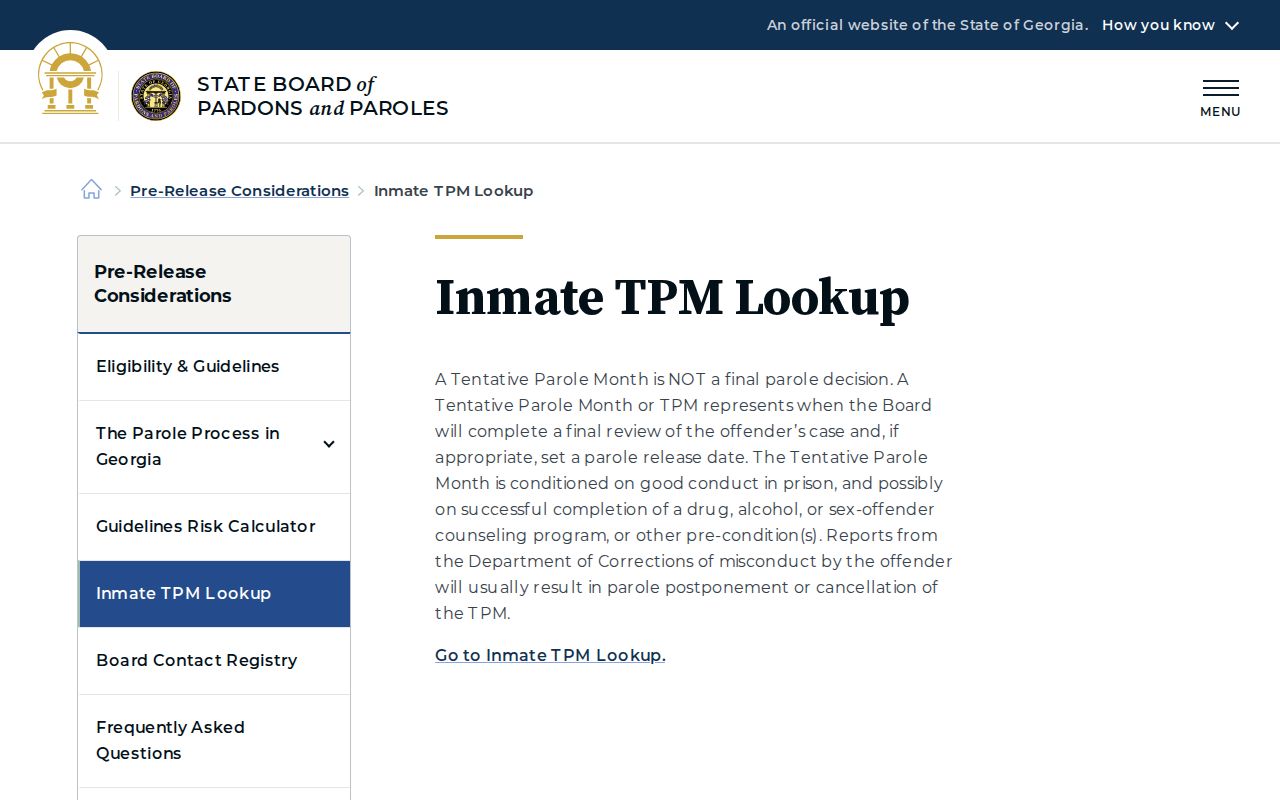
The source confirms that final review occurs later and may produce a parole release date only when appropriate.
Lee County Supervision Office
Lee County is assigned to the Americus DCS Field Office, not an office in Leesburg. The office serves Lee, Macon, Schley, Stewart, Sumter, and Webster counties within the Southwestern Judicial Circuit. A person released from Lee County Jail or Lee State Prison may therefore have to report in Americus when felony probation or parole applies.
The official office entry is the best source for current routing details before an in-person visit.
The Americus office listing identifies its Lee County service area.
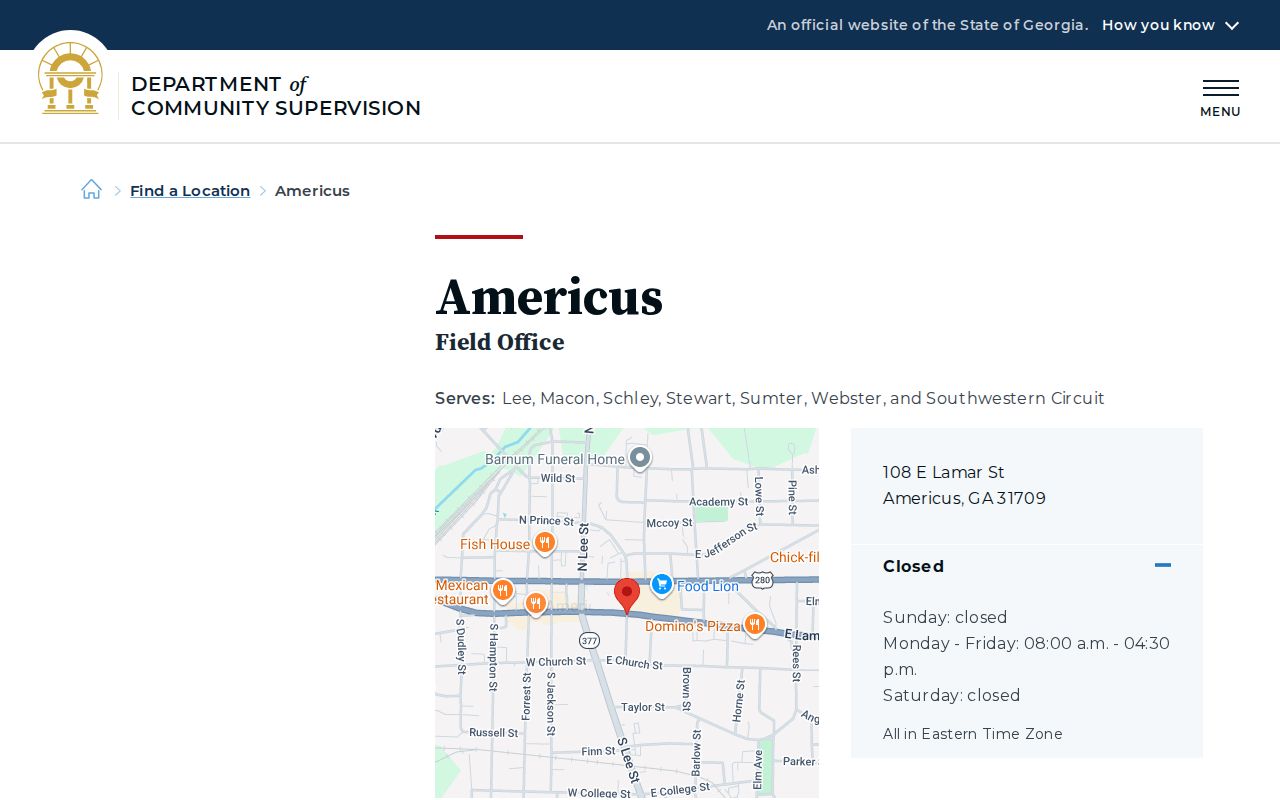
This office listing connects Lee County post-release supervision to the correct regional field location.
Lee County Violations and Warrants
Supervision conditions are the written rules attached to parole or probation. They can include reporting, travel limits, treatment, payment, or other case-specific duties. A violation allegation does not by itself show the final result. Probation issues return to the sentencing court. Parole violations follow Board procedures that may include preliminary and final revocation hearings.
An absconder label means the agency alleges that contact or reporting stopped. It should not be inferred from a missing online result. Confirm any warrant or violation through DCS, the Parole Board, the court, or the law-enforcement office that holds the warrant. Georgia VINE can provide custody-change alerts, but it is not the official supervision case file.
Sex-offender registration is also separate from parole and probation. The GBI registry is a distinct statutory system whose data changes as agencies report updates.
GDC Funds After Lee Release
A practical detail differs by release system. The GDC Georgia Release Card can receive funds left on a state offender's account after release. The card uses a PIN and may support cash-back or ATM access. That process concerns a GDC prison release. It does not describe property, money, or bond handling for an ordinary release from Lee County Jail.
Keep the records separate when helping someone plan for release. GDC handles a state-prison account, DCS handles field supervision, and the county jail controls its own release property process. A parole status does not prove that a release card is ready, and a release card does not establish current supervision.
Lee County Parole Eligibility Limits
Parole eligibility is not the same as parole approval. The Board says most parole-eligible Georgia inmates become eligible for consideration after serving one-third of the prison sentence. Board guidelines then consider crime severity and risk, but the members may accept or reject a guideline recommendation. A favorable review can result in a TPM with conditions. A denial can lead to a later reconsideration date when the rules allow it.
Some state sentences follow different limits. The Board's FAQ says non-life sentences for listed serious violent felonies committed on or after January 1, 1995 are not parole eligible and require service of the full prison term imposed by the judge. The listed group includes murder, rape, aggravated child molestation, aggravated sodomy, aggravated sexual battery, armed robbery, and kidnapping. Fourth-felony recidivists, life without parole, and death sentences also have distinct exclusions. These rules concern parole eligibility, not probation ordered by a Lee County court.
Use the sentence and current Board record for the individual case. A general fraction cannot establish a release date. GDC owns the sentence computation, while the Board owns parole consideration. If those records appear to disagree, ask each agency to verify the field it created.
Lee County Parole Release Notices
Georgia VINE and the Georgia Office of Victim Services provide notification paths, but they serve different records. VINE can send custody-change notices from participating agency feeds. Depending on the current setup, registration may offer phone, text, email, TTY, or app delivery. Phone notices can use a four-digit PIN to acknowledge the call and stop repeated notification attempts.
For a final parole decision, the Parole Board FAQ cites the victim-notification duty in O.C.G.A. § 42-9-47. That notice is separate from a public jail roster and from the Board's monthly meeting calendar. A person tracking one Lee County case should keep contact information current with the appropriate victim-services program and use the Board lookup for the offender's parole record.
A notification reports a custody or decision event. It does not replace the written release, discharge, or supervision record. Compare the notice with GDC status and the Americus DCS assignment when the person enters community supervision. Save the notice date and agency name so a later records request can identify the same event without confusion.
Ending Lee County Supervision
Supervision ends through an official discharge, expiration, early termination, or other order. Finishing a jail stay is not the same event. The Parole Board controls parole discharge under its rules, while the sentencing court controls probation terms and modifications. DCS can confirm field-office information but does not replace the order or discharge record.
An early end should never be assumed from time served in the community. Board rules allow parole discharge in defined circumstances, and a court can address probation according to the sentence and Georgia law. Until an order or agency record shows the change, the last verified supervision status remains the sound reference point. If a person has moved, a field-office transfer can also change where reporting occurs without ending the underlying term.
Keep the final paperwork. A parolee search may change, and a roster entry may vanish. The originating agency's record is stronger evidence of the end date. For the larger release trail, including jail records, court dispositions, and GDC status, use the Lee County released inmate search.
A final check should compare the discharge date, the court case, and any custody event that occurred during supervision. That is especially useful after a violation allegation, since a new jail stay and the original supervision term can overlap in the record trail. Ask for the document by name: parole discharge, probation termination order, revocation decision, or amended sentence. Each one answers a different question.
Note: A blank search result does not prove that supervision ended; verify the discharge with the agency that issued it.
Public Record Search
Sponsored Results