
Lee State Prison Release Paths
Lee State Prison is a Georgia Department of Corrections institution for sentenced adult male felons. Its custody exits differ from Lee County Jail releases. A state offender may leave through parole, completion or maximum expiration of the sentence, transfer to a transitional center, transfer to another prison, court transport, or an administrative or medical move. The record must be read for the type of event, not just a changed facility name.
Parole is a conditional release granted by the Georgia State Board of Pardons and Paroles after part of a prison sentence. Discharge or max-out means the prison term ends, though another legal duty can still exist. A transfer means GDC custody continues at another site or status. Transitional custody can place a person closer to community reentry without constituting full sentence discharge. These distinctions determine whether GDC, the Parole Board, DCS, or a receiving institution holds the best current record.
| GDC event | Custody meaning | Verification source |
|---|---|---|
| Parole release | Prison custody ends under Board conditions | GDC, Parole Board, and DCS |
| Sentence discharge or max-out | The state prison term reaches its recorded end | GDC offender record and Inmate Records |
| Transitional placement | The person moves within a structured GDC pathway | Current GDC record and facility status |
| Prison transfer | State custody continues elsewhere | GDC current facility information |
| Court or administrative move | Physical location changes without proven discharge | GDC plus court or receiving record |
Confirm Lee State Prison Release
GDC Find an Offender is the correct public search, not Citizen Connect. Search by full name when no identifier is known, then narrow the match with age or identifying details. A GDC ID or case number can provide a more direct match. Review status, current facility, sentence information, and any release or discharge field that the record displays.
- Search the official GDC form by name, GDC ID, or case number.
- Match identity details before relying on a result with a common name.
- Read the custody status and facility fields to distinguish Lee State Prison from another GDC site.
- Check release, discharge, sentence, or parole fields shown on the record.
- If parole appears, compare the Parole Board record and DCS supervision route.
- Request written GDC verification when the exact date or status affects a court or records matter.
GDC cautions that web information may not be complete. Its search disclaimer directs formal verification to Inmate Records and Information. A displayed date can also change when sentence credit, non-running time, court instructions, disciplinary action, or other official calculations change. The Projected Release page separates a tentative or computed date from an actual custody exit.
Lee State Prison Transfer Hub
The official GDC facility page identifies Lee State Prison as a transfer hub and host facility for the Albany Transitional Center. This local role makes physical departure especially easy to misread. A person who leaves Lee State Prison may have transferred elsewhere in GDC or moved into transitional custody. Neither event proves full release to the community.
Read the newest GDC facility and status fields together. If a new institution appears, custody likely continued there. If transitional status appears, verify the program and supervision terms through GDC. If parole appears, use the Parole Board and DCS. A release or discharge entry should still be checked against Inmate Records when an exact effective date is needed.
The matched official page shows the institution's role and GDC facility information:
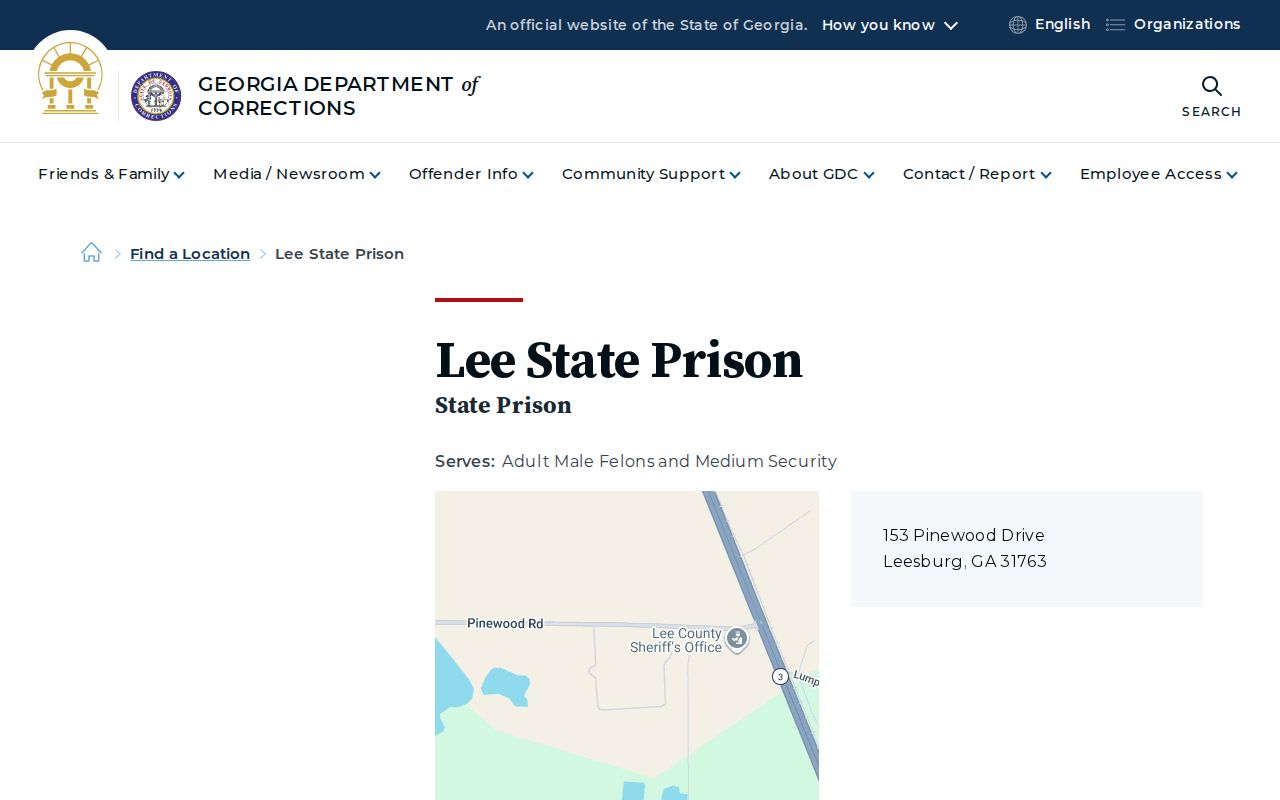
The transfer-hub label is central to release research. Leaving this prison is not always the same as leaving Georgia corrections custody.
Lee State Prison Parole Release
The Georgia State Board of Pardons and Paroles decides parole. Most parole-eligible inmates become statutorily eligible after one-third of the prison sentence, but eligibility does not guarantee release. The Board may set a Tentative Parole Month, or TPM, deny parole, or change a prior decision before the release takes effect. A TPM marks the month for final review. It is not a final release date.
Use the Inmate TPM Lookup while the person remains incarcerated and the Parolee Search after a parole release. Conditions, misconduct, or unmet program requirements can postpone or cancel a proposed release. A final parole event should align with GDC's custody record and the supervision record.
The Georgia Department of Community Supervision supervises parolees in the community. Lee County is served by the Americus DCS Field Office. A person can be out of prison yet remain under state supervision. Parole discharge, which ends supervision, is a later and separate event. The Probation & Parole page explains the lookup and local reporting distinction.
- TPM
- A tentative month for final parole review, not a promised release date.
- Parole
- Board-authorized release from prison under supervision and conditions.
- Discharge
- The recorded end of custody or supervision, depending on the agency record.
- Max-out
- Completion of the maximum prison term as officially calculated.
Lee State Prison Release Records
Questions about a specific state offender, transfer, or release record belong with GDC. Include the full name, GDC ID, date of birth, conviction or case number if known, facility, and the precise record requested. Ask for the release date, discharge date, max release date, parole release, or sentence-computation verification rather than a broad file when one issue is at stake.
GDC Inmate Records and InformationPO Box 1529
Forsyth, GA 31029
Georgia Department of Corrections
300 Patrol Road
Forsyth, GA 31029
Inmate concerns/questions: (404) 656-4661
Written correspondence is the verification route named in the GDC offender-search disclaimer. The facility can answer institution-specific questions, but central GDC records are the stronger source for official sentence and discharge verification. A request should distinguish the date a person left Lee State Prison from the date GDC custody ended. Those dates may differ after transfer.
Lee State Prison153 Pinewood Drive
Leesburg, GA 31763
Phone: (229) 759-3110
Fax: (229) 759-3065
Visitation listed by GDC: Saturdays, Sundays, and state holidays, 9:00 a.m.-3:00 p.m.
Lee State Prison Details
GDC describes Lee State Prison as a medium-security institution for adult male felons. It was constructed in 1978, opened in 1979, and renovated in 2002. The sourced capacity is 762. These facts identify the state prison and should not be applied to the nearby county jail. The institution is operated by GDC, while the county Criminal Justice Center is operated by the Lee County Sheriff's Office.
The nearby locations can cause a false match when a family member remembers only Pinewood Road. Confirm the street number, agency, and inmate identifier. Lee County Jail uses local booking records. Lee State Prison uses GDC offender records. A county release to GDC is a transfer into state custody, and it does not prove placement at this specific prison.
Lee State Prison Release Dates
A state sentence date begins with the court's sentence and applicable jail credit or special instructions. GDC rules define sentence begin and sentence end concepts, including non-running time and earned-time credits. GDC's Performance Incentive Credit program may reduce length of stay for eligible offenders through progress in programs, education, vocational work, work details, and good behavior. It excludes several categories, so no simple public formula should be used to predict an individual's date.
Georgia does not apply a generic 85 percent statement to every state sentence. The Parole Board says listed non-life serious violent felonies committed on or after January 1, 1995 are not parole eligible and require service of 100 percent of the term imposed. Other exclusions also exist. Use the actual sentence, GDC record, and Board status rather than a broad rule.
| Date or status | What it means |
|---|---|
| Sentence end | The maximum end as officially computed, subject to authorized changes |
| TPM | A parole review month, not final release |
| Parole release | Release under Board conditions and DCS supervision |
| Discharge or max-out | Completion shown in the official state record |
| Transfer date | Movement between facilities or statuses, not necessarily release |
Lee State Prison Status Cross-Checks
Georgia VINE can provide custody status and notification options for participating agency records. It is useful for alerts, but it is not a complete GDC offender file or certified discharge record. Search the correct person, compare the agency and identity details, then verify the result with GDC. A missing VINE result does not prove that no state custody history exists.
The sentencing court can explain the judgment that began the term. GDC calculates and administers the sentence, and the Parole Board makes parole decisions. Each record answers a distinct question. If a date changes, look for corrected jail credit, non-running time, earned credits, a new court order, discipline, parole conditions, or a facility transfer. Written verification should come from the agency responsible for the field in dispute.
For a full named-person search across county and state systems, use the Lee County released inmate search. It preserves the boundary between a Sheriff's jail exit and a GDC prison release.